Can you work with chronic illness?

The honest answer to whether you can work with chronic illness is: it depends. It comes down to how you manage capacity and how you structure your work.
For some people, working with chronic illness is possible and sustainable, sometimes with changes, sometimes without.
For others, it is possible in a reduced or altered form.
What makes this easier to navigate is understanding that there are distinct stages in how people work with chronic illness, and what is possible at each stage. This is partly about physical capacity, and yes, it does include medical information.
But many of the decisions sit in how you work, not just whether you can work or sustain your career.
What working with chronic illness depends on
Whether someone can work with chronic illness is shaped by several things at once.
The nature of the illness matters.
Some conditions are relatively stable or have extremely clear treatment pathways that map when physical capacity will be reduced and when it will be restored.
Other chronic conditions are more unpredictable, fluctuating day to day or week to week in ways that are difficult to anticipate.
Capacity matters, and this is not the same as diagnosis.
Two people with the same condition can have substantially different capacity.
What is available on any given day, physically, cognitively and emotionally shapes what work is possible and on what terms. But a significant part of that capacity is not just physical. It is the mental and emotional load of managing work with chronic illness, tracking symptoms, making decisions about what to say or not say, and sustaining performance while doing both.
It is possible to significantly reduce the mental and emotional overwhelm, which frees up more capacity for sustainable work.
Where someone is in their experience of the illness also matters.
The early period after a diagnosis is often one of the most disorienting. Treatment can have just as big an impact as symptoms.
The gap between what someone could do before and what they can do now is often most visible here.
What working can look like
Most people spend their time testing and redesigning their current role, or making changes so they can have optimal impact without sacrificing their health.
This can look like:
- Continuing to work full-time, with or without adjustments
- Working part-time, by necessity or by deliberate design
- Working intermittently, project-based or seasonal, or moving in and out of employment as capacity allows
- Changing roles or industries, including transferring your skills into a better working environment
- Redesigning how you work entirely, including the hours, structure, load, and environment
- Starting your own business, consultancy, or online work
What needs to be understood
Firstly, your talent, skills and expertise will always remain. What fluctuates is your capacity, physical, mental and emotional, and sometimes how your skills are applied and delivered.
So working with chronic illness requires a different way of understanding capacity, and the key focus becomes how you work. The old way of pushing through, over-extending, and the crash and burn cycle is no longer sustainable.
Here’s what to understand:
The energy required to work is not just the work itself.
It includes everything around it: commuting, preparing, communicating, maintaining relationships, and managing the administrative side of work. This can all be managed with resources that are tailored to chronic illness.
Recovery is also part of capacity.
A day of focused or demanding work may require time to restore, and that needs to be included in how work is structured.
Cognitive capacity plays a central role.
Concentration, decision-making, communication, and problem-solving all draw from the same pool as physical energy, and are often affected directly or indirectly.
Variability is part of the pattern.
What is available on one day may not be available on another, and work needs to be designed with that in mind. That variability is not always visible to employers or colleagues.
What supports this
The key things that make this easier are:
Clarity about your capacity matters.
Having a clear understanding of what you can sustain is foundational to how your work is designed.
- Building in recovery time, daily, weekly, or monthly depending on your condition
- Creating consistent rhythms that support stability week to week
Decision-making becomes clearer.
Knowing what you will and won’t take on allows your role to align with your actual capacity.
- Giving yourself permission to redesign your work and life so that it is sustainable, including financially
- Focusing your role on what actually matters, rather than carrying everything
Communication becomes more deliberate.
What you share, when, how, and with whom shapes how your work is supported.
- Being able to set and hold boundaries around your time, energy, and role
- Share what you can do, rather than start with a list of what you can't
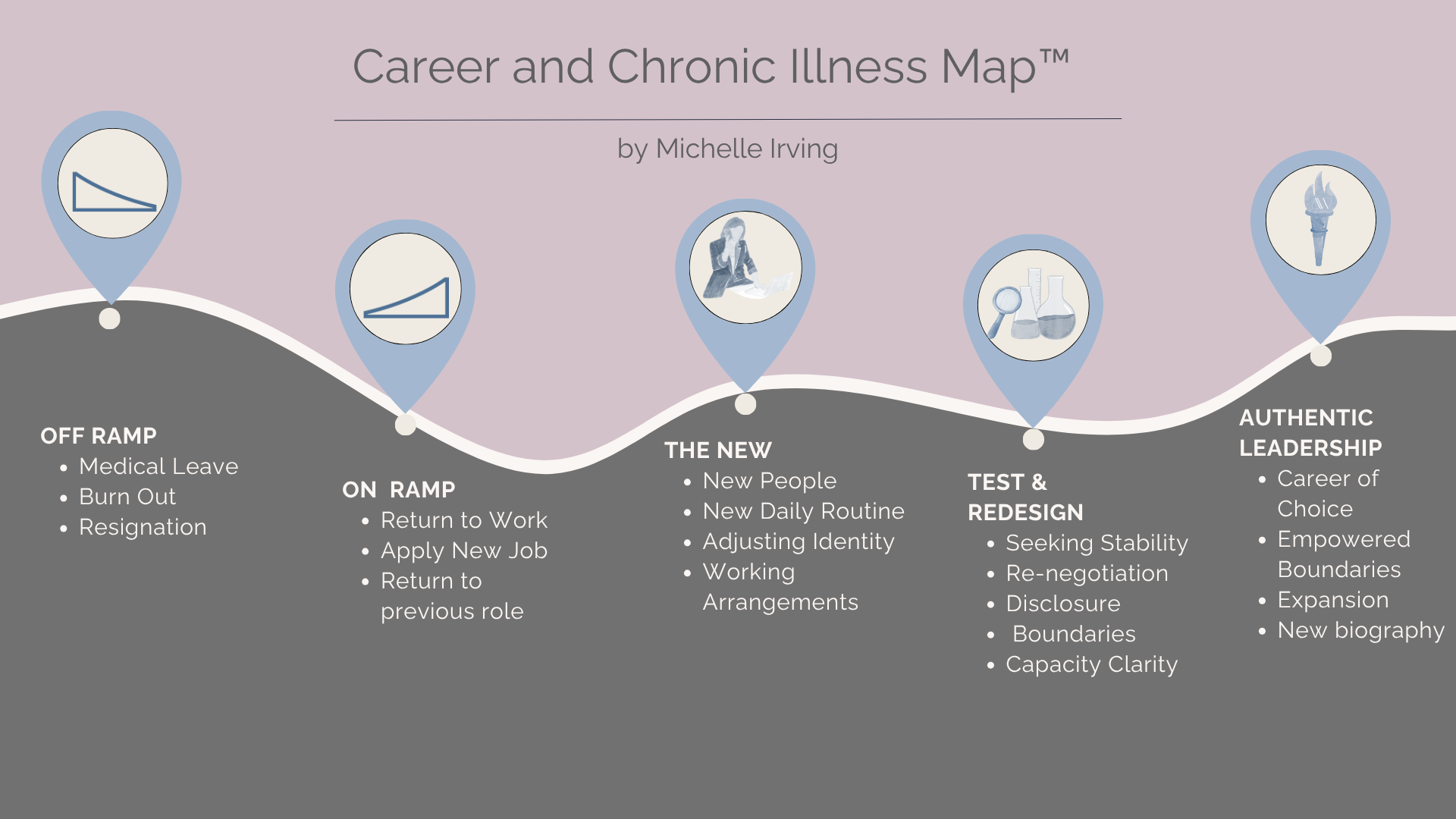
Where the Career & Chronic Map™ helps
The question of whether you can work with chronic illness is not fixed. How you work may shift over time, especially as your capacity contracts and expands.
Most people judge themselves based on their best day, as if that should be the baseline every day. But that is not how capacity works.
What makes this easier is understanding that there are five career stages in managing your work with chronic illness. Each stage has distinct shifts that make work more sustainable.
The Career & Chronic Map™ was built to make that visible. It shows the stages people move through and how the key decisions, including this one, shift depending on where you are.
The Map is where to start.