How to deal with chronic illness at work

Managing chronic illness at work is not a single problem with a single solution. It is the reality of trying to work within a system that assumes stable capacity, when your capacity may fluctuate.
How you work with chronic illness depends on how capacity is managed and how work is structured.
If you are searching for how to deal with chronic illness at work, you are already performing wellness:
- Trying to maintain top level output on days when symptoms are high.
- Calculating how much you can take on without triggering a crash.
- Deciding what to disclose, to whom, and when.
- Minimising the appearance of illness or playing it down at work.
The physical impact of chronic illness at work is only part of the picture. The one we don’t talk about often enough is the mental and emotional load that runs alongside the symptoms.
- The anticipation of a difficult day.
- The recalibration required when plans change because your body changed.
- The effort of managing other people’s perceptions while also managing your own health.
- The gap between how you want to show up and what your body is making available.
What this requires
What is within your control
This includes how you structure your working day, how you allocate your energy across tasks, and how you sequence work to match your actual capacity, rather than measuring yourself against your best day and pushing through until you collapse.
Most people with chronic illness know their body has patterns. Whether their work structure reflects those patterns is less consistent.
What requires negotiation
Deadlines, expectations, communication with managers or colleagues.
Most people wait until there is a problem before they say anything, and by then they are already over capacity.
What tends to work better is raising things earlier, while there is still room to shape the timeline or the scope of the work. Keeping it grounded in what you can do, rather than waiting until you are explaining why something can’t be done.
What is structural
There is a difference between what is expected, and what is built into how an organisation operates.
When you focus on impact, what is delivered instead of how it is delivered, you have more leverage within your role design and performance frameworks.
The underlying assumption in most jobs is that work is done with stable, consistent capacity.
The key question is whether something is about your impact, your manager, or the organisation more broadly. That assessment helps you decide where to focus your energy.
Separating these does not solve anything immediately. But it changes what you are trying to solve.
What this means for how you work
Baseline and best day capacity
A good hour, day or week of capacity can easily become the standard, for yourself and for others. When capacity shifts, it can feel like something has gone wrong, rather than recognising that fluctuation is part of how capacity works.
The focus is on adjusting and managing your impact across that cycle.
This includes the mental and emotional side, reducing self-criticism and expectations that don’t hold with chronic illness.
Accounting for recovery
Recovery is part of how work is sustained.
For most people with chronic illness, work does not end at the end of the working day. Time to reset, restore, and stabilise is part of what makes ongoing work possible. When this is factored in, work becomes easier to plan and maintain.
Sustainable work is not about doing the same thing every day. It is about being able to work across the cycle of chronic illness, with different ways of working for different levels of capacity, and the ability to adjust without losing continuity.
This allows work to be shaped in a way that supports both output and capacity, rather than working against either.
How this comes together in practice
Capacity shifts are accepted
Working with chronic illness requires accepting that your capacity will fluctuate. Accepting this reduces the mental and emotional load of trying to hold a standard that doesn’t fit. Work is then planned around that.
How work is structured
The focus becomes what is actually possible on a given day, rather than holding one standard across all of them.
Different ways of working
Different days are worked differently. The aim is not to make them look the same.
Recovery is integrated
Recovery sits inside the rhythm of the work, not separate from it.
Boundaries and communication
Clear boundaries keep the focus on impact.
When these are working together, work becomes more consistent. Not because capacity is fixed, but because it is being worked with.
Where the Career & Chronic Map™ helps
This is not something you work out once.
How you work will shift over time. As capacity changes. As treatment changes. As your role changes.
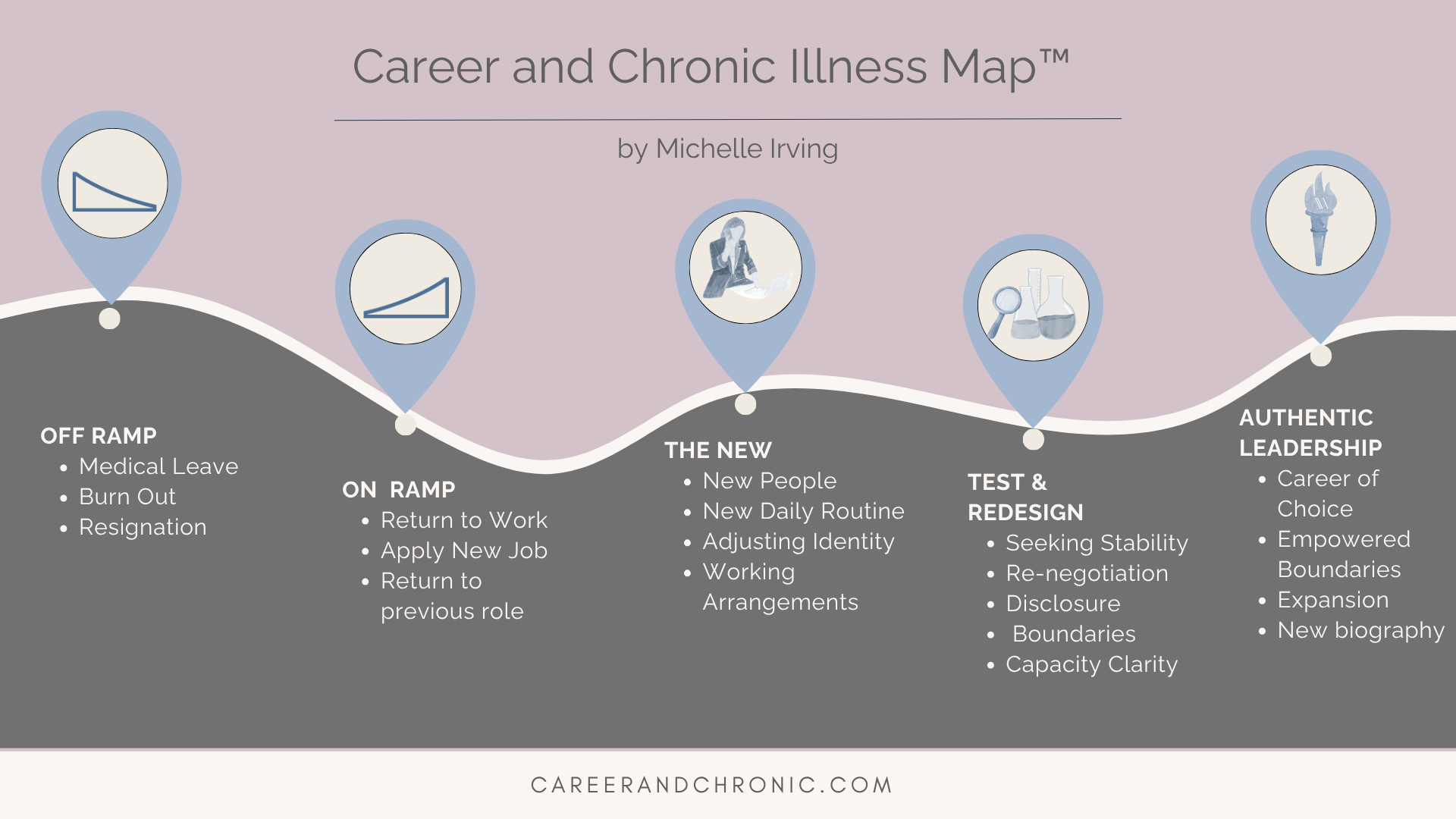
The Career & Chronic Map™ shows the stages people move through when working with chronic illness, and how what matters shifts at each stage.
It gives structure to what can otherwise feel inconsistent, and makes it easier to see what matters at any given point.
The Map is where to start.